SecondWindGroup
patreon

NOTE: This piece contains spoilers for the first season of Batman: The Caped Crusader, available on Prime Video now. It’s solid, if not quite spectacular.
It is a cliché to describe the location of a story as a major character within the narrative, to suggest that New York City is the “fifth character” on Sex and the City or that Los Angeles is “the real star” of Once Upon a Time… in Hollywood. Still, the recently launched streaming series Batman: The Caped Crusader is at its strongest when it feels like a show about the fictional Gotham City. If nothing else, the series constructs a compelling argument for why Gotham City needs Batman (Hamish Linklater).
Still, Batman has one of the most iconic rogues’ galleries in comics. Indeed, several recognizable villains appear in the first season of Batman: The Caped Crusader: the Penguin (Minnie Driver), Catwoman (Christina Ricci), Harley Quinn (Jamie Chung) and Clayface (Dan Donohoe). The bulk of the season is devoted to the familiar arc that sees District Attorney Harvey Dent (Dietrich Bader) transformed into the monstrous Two-Face. The season closes with a short tease of the Joker.
Batman: The Caped Crusader is being positioned as something of a spiritual successor to Batman: The Animated Series, perhaps the greatest superhero television show ever produced. Much has been made of the involvement of Bruce Timm, creator of The Animated Series. Although the art style on The Caped Crusader is more heavily influenced by Golden Age artists like Dick Sprang than the art deco approach of The Animated Series, both shows share a similar retro film noir aesthetic.
However, there is a marked difference in how the two shows approach the character of Batman. After all, the tone and mood of The Animated Series was largely defined by writer Paul Dini. Dini tended to construct episodes as elaborate character studies of classic villains, often turning ridiculous antagonists like Mister Freeze (Michael Ansara), the Mad Hatter (Roddy McDowell) or Scarface (George Dzundza) into truly tragic – and often sympathetic – figures.
The Caped Crusader makes a few attempts to emulate this approach early in its season, with the first two episodes focusing on a gender-flipped take on Penguin and retro version of Clayface that harks back to the character’s four-color origins. These are easily the weakest episodes of the ten that compromise the season, in large part because they feel like an unconvincing imitation of something that The Animated Series perfected.
The show seems to acknowledge as much with its third episode, “Kiss of the Catwoman.” This features perhaps the most conventional villain origin of the season and provides the framework for the obligatory flashbacks to Bruce’s own childhood trauma. Of course, everybody knows Batman’s origin story, beat-for-beat. It’s all very tiring and familiar. There is a sense of obligation to all this. This is the stuff that every Batman adaptation has to work through.

That frustration is woven into “Kiss of the Catwoman.” After punching out reporter Eel O’Brien (Tom Kenny), Bruce Wayne is sentenced to therapy with Harleen Quinzel, where he is obligated to relitigate his formative trauma over his own better judgement. Neither Wayne nor Quinzel seem particularly satisfied by the court-mandated experience. “Did you really not get anything out of talking to her, sir?” Alfred (Jason Watkins) asks. Bruce curtly replies, “I’m fine. Now drop it.”
In the same episode, fallen socialite Selina Kyle reinvents herself as the costumed Catwoman. The dynamic between Batman and Catwoman has long been flirtatious; the romance between the pair was foreground in writer Tom King’s recent extended run on the Batman comic. However, in The Caped Crusader, there is no chemistry between the pair. Bruce has no real interest in Selina. In the episode’s final scene, Bruce admits, “Gotham’s got a break from her nonsense – and so have I.”
Indeed, “Kiss of the Catwoman” represents something of a sharp pivot for The Caped Crusader. It is the point at which, having established its bona fides, the series can take a turn towards its own unique interests. The climax of the episode finds Gotham City Police Department Lieutenant Arnold Flass (Gary Anthony Williams) threatening to execute Selina in retaliation for his humiliation early in the episode. Photographs of Batman subduing a police officer turn him into a public enemy.
If Paul Dini was the defining creative voice on The Animated Series, Ed Brubaker is a major influence on The Caped Crusader. Brubaker is a veteran comics writer who worked on several Gotham-set titles in the early 2000s: Batman, Catwoman and Gotham Central. Brubaker’s influence on The Caped Crusader is obvious. The second episode, “And Be a Villain”, was written by Greg Rucka, who wrote on Detective Comics alongside Brubaker’s Batman and who co-wrote Gotham Central.
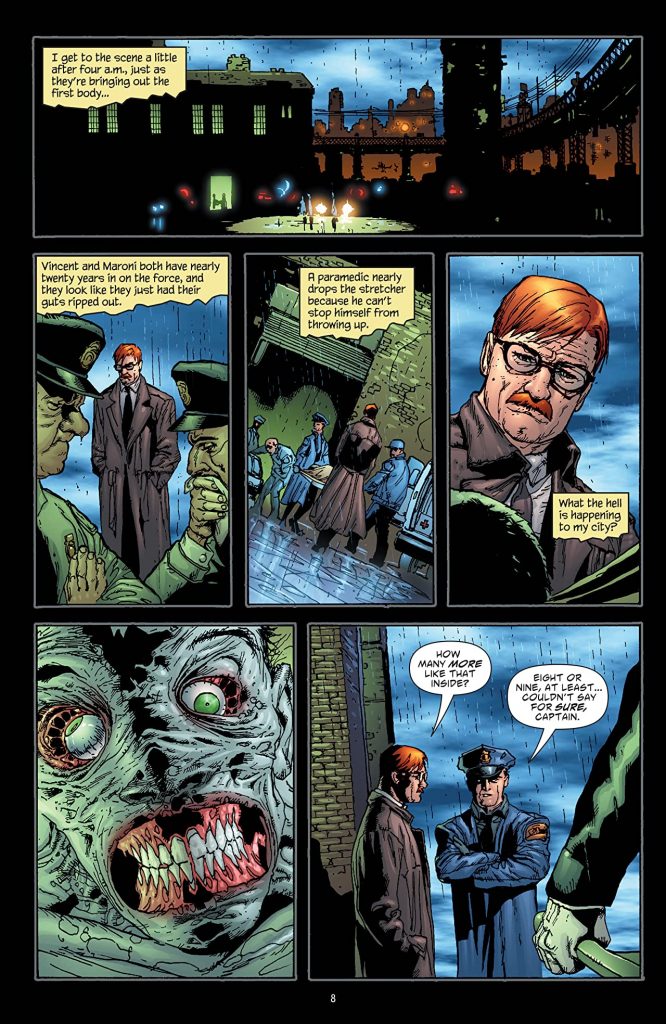
Indeed, The Caped Crusader takes many of its cues from Brubaker’s work on Batman. There’s a heavy emphasis on “the East End”, a derelict part of Gotham created by Frank Miller and Dave Mazzucchelli for “Year One”, but which featured so heavily in Brubaker’s work that the blockbuster collection of his Catwoman run is titled Cat Woman of the East End. The tease of the Joker at the end of the season is framed to evoke Brubaker’s introduction of the character in The Man Who Laughs.
While Dini’s approach to Batman tends to focus on developing the villains, Brubaker was always more interested in the relationship between Batman and the city itself. Gotham Central is one of the best Batman comics ever published, and it barely features any superheroes. It is instead focused on the police officers working major crimes in Gotham, operating in the shadow of the Batman and his rogues’ gallery. The best parts of The Caped Crusader carry some of that approach over.

The Caped Crusader is very interested in the structures and systems of Gotham. Not only is Harvey Dent serving as District Attorney, he is running for Mayor. Not only is Commissioner James Gordon (Eric Morgan Stewart) head of the Gotham City Police Department, his daughter Barbara (Krystal Joy Brown) is a public defender trying to protect the rights of those in police custody. Bruce spends most of his time in the Batcave contemplating a map of the city. The show’s opening and closing credits focus on the empty spaces of Gotham – offices, apartments, meeting rooms.
The characters themselves are intertwined with the city’s infrastructure. Dent monologues about how the train lines are “the arteries of [this] great city” and the workers “form the beating heart of Gotham.” A late-season episode, “Nocturne”, features playful cameos from a gaggle of Batman’s future sidekicks: Dickie (Carter Rockwood), Jace (Henry Witcher), Stephie (Amari McCoy) and Carrie (Juliet Donenfeld). Before they become Bruce’s wards, they are wards of the state: orphans in the care of Doctor Leslie Thompkins (Donna Lynne Champlin).
Obviously, Gotham is modelled on New York City. In the words of legendary Batman writer Denny O’Neil, Gotham “is Manhattan below Fourteenth street at eleven minutes past midnight on the coldest night in November.” However, because Gotham is a fictional construct, it can take on a life of its own, as demonstrated by Anton Furst’s design work for Tim Burton’s Batman. In The Caped Crusader, there is a real effort to explain how Gotham City could produce a hero like Batman.
The Caped Crusader suggests that real monsters in Gotham aren’t the supervillains, but instead the corruption, indifference and poverty that have taken root. Bruce listens to reports on how “inflation and unemployment in Gotham continue to rise.” A security guard (Kari Wahlgreen) laments, “I remember when these factories were open around the clock.” She opines, “We had a government worth a damn, we’d rebuild. Pump some life back in. But instead we get to keep the slums.” Lieutenant Renee Montaya (Michelle Bonilla) complains that “richies can’t stomach the real Gotham, so just leave instead of making the city better.”
Wealth is a recurring preoccupation for the season, even beyond the Wayne fortune. Frustrated by the indifference of her privileged clients who refer to their workers as “chattel” and complain that they “want to unionise”, Harleen Quinzel reinvents herself as the vigilante Harley Quinn in “The Stress of Her Regard”, warning the city’s wealthy that “the kings don’t run this court any more - the jester does.”
In “Night Ride”, Batman faces “the Gentleman Ghost”, the spirit of James Craddock (Toby Stevens) who “only targets the underprivileged.” Like Bruce, Craddock was a wealthy vigilante, but he didn’t bring salvation to the needy. “James Craddock was no Robin Hood,” explains a librarian (Gaille Heidemann). “He robbed from the poor to give to himself.” Craddock longs to return to “a better time”, when “the lower classes knew their place.” Indeed, if Bruce has a character arc over the course of the season, it’s coming to see Alfred as more than just a function, to stop calling him “Pennyworth” and start calling him “Alfred.”

It isn’t just the city’s wealthy that prey on the impoverished and disenfranchised citizens. In “The Night of the Hunters”, Flass unleashes the supervillain Firebug (Kenny) on a tenement building to draw Batman out into the open, risking countless innocent lives. In “Moving Target”, a contracted hit forces James and Barbara Gordon to go on the run because they can’t trust the police department. This paranoia is well-founded; Lieutenant Jim Corrigan (Roger Craig Smith) proves himself a rat.
While the season builds to the familiar story of Harvey Dent’s transformation into Two-Face, the subject of countless Batman stories, The Caped Crusader finds a fresh angle. Harvey is incarcerated in the season’s penultimate episode and the season finale finds him being hunted by the police when he promises to testify in the hopes of revealing “where the bodies are buried” and “exposing corruption.” Dent is ultimately shot in the back by Flass, executed by a police officer.
Flass insists that it was “a righteous shoot” as Batman squares him down. “You can’t do this,” Flass warns the hero. “You’re just some lousy vigilante. I’m a goddamn cop!” It’s the most powerful moment in the series, particularly in the aftermath of national protests about the use of lethal force by police officers who have rarely faced legal consequences for their actions. In that moment, Bruce’s anger is palpable, justifiable and feels incredibly timely despite the show’s noir setting.
It's a moment that really makes an argument for Batman as a vigilante. After all, the Dark Knight is frequently (and increasingly) criticized as “a billionaire aristocrat who beats up poor people.” The Caped Crusader is less interested in Bruce Wayne’s internal psychology than other adaptations, less compelled by the arguments about why Bruce would choose to be Batman. Instead, the series explores how broken Gotham must be to justify Batman, to make Batman a logical response.
It's a fresh and fascinating angle on the classic Batman mythos, and it allows The Caped Crusader to feel like more than just a pale imitation of The Animated Series. It’s a show less interested in the well-trodden takes on Batman and his iconic villains than it is engaged with the world in which they operate.
Something I really loved was the inversion of the use of Two-Face's face. Historically, they show the unscarred face when Two-Face is being nice, and the monstrous face when he's being monstrous. But in the Caped Crusader, the monstrous face is pensive and, if not well meaning, at the very least aware of the consequences of his actions. It's the beautiful side that is narcissistic and cruel.
Yep. Although I do hope they do bring in more B-, C- and D-list players like Firebug and Onomatapeia.
Yep. I found it very charming.
Interestingly, I'd argue "The Batman" still circles around the Waynes. You have the Riddler's obsession with Thomas Wayne and the tease that he might even be Bruce's half-brother. And then the whole Falcone/Thomas Wayne angle stuff. In terms of Marvel and DC, I think it's worth considering how the universes were created in the comics. Allowing for exceptions like Cap and Namor, the bulk of the MCU was created by Lee/Ditko/Kirby in the 1960s intended to fit together from the beginning. So it makes sense that they all cohere relatively well. In contrast, DC was created piecemeal. Originally, Batman, Superman and Wonder Woman didn't share a continuity. And then you had the addition of Barry and Hal in the 1950s. Then you had characters who weren't created by DC, but were bought from rival companies - like Shazam or the Atom or the Question. So, I think it makes sense that those don't always mesh cleanly. More broadly, though, there's also the studio thing. Disney is a very corporate studio, interested in itself as a brand and fitting everything within that. Jon Favreau is Disney's go-to auteur, to illustrate the point. I got no issue with Favreau. He seems lovely. But he doesn't exactly scream "guy with a strong perspective on the world." In contrast, Warner Bros. have historically been more creator-driven. More trusting of artists. They are home to Eastwood. They were home to Nolan and Kubrick. They fostered long-term creative relationships with people like Bradley Cooper. They generally trusted artists. So, as a result, their stronger stuff tends to be more driven by individual perspectives.
To be fair, I'd disagree with the argument Bruce has historically been underserved. I know people point to the two Tim Burton "Batman" movies as an example, but I love that version of Bruce as a sort of inverse Burton protagonist. He's surrounded by the kinds of weirdos and freaks that typically populate Burton movies, but he's ultimately a normal guy who tries to express his inner freak. ("You're just jealous cause I'm a real freak and you have to wear a mask!" "You might be right.") I think that's a fun and interesting angle on the character, one that stands apart from the tortured orphan and gritty urban vigilante that is the default. He's one of Burton's most interesting lead characters because of that, and one that I think about a lot. That shot of Bruce waiting in his study for the Bat-signal to come on "Batman Returns" tells me more about him as a character than I know about, say, the internal psychology of Mark Ruffalo's Hulk. And the Nolan "Batman" movies are very firmly rooted in Bruce's internal psychology. I think "Batman Begins" is maybe the best superhero origin story ever, because it really commits to the idea of "... what would it take for a guy to think that this was a good idea?" and it explores how a man could get to the point where creating "Batman" seems like a rational act. And then "The Dark Knight" is about Bruce reckoning with what he has created, and realising that he's trapped himself within a monster that he has built. As such, I do tend to - personally - treat "The Caped Crusader" as the exception rather than the rule. And I think that adds to the show's novelty. Its disinterest in Bruce isn't part of a larger pattern, but a deviation from it.
Oh yeah. The beauty about comic books is that they are populated with archetypes and metaphors, built on symbolism and imagery, and so lend themselves to this sort of abstract storytelling, where watching two people in costumes pummelling one another takes on a sort of mythic resonance. After all, Superman is the ultimate American, for example. It's something I love about the superhero genre.
I love the art direction in this series. The look and feel of the world and the characters is gorgeous! The sense of huge space everywhere is incredible - Gotham sprawls, and its civic buildings, mansions and even utilitarian spaces are cavernously large. Yet the land is not choked with development - outside the city proper, there is a lot of natural space between features. It is like Gotham is too big for the influence of Man to have any lasting effect upon her. Buildings may be blown up or burned down, but the city stands unchanged. There were some interesting and deliberate animation choices, with all the people walking or running with almost comically short steps - not shuffling, but looking like their strides could not cover much ground - I think that accentuated their smallness within the massive scenes. This all leads me to agree with you, Darren - THIS Gotham is a villain, a chaos, an entropy that can be pushed back but never beaten. I enjoyed the few Easter eggs that I spotted - I'm sure there were many more - with the reference to Dozier Street delighting me the most (William Dozier directed the 1966 Batman TV series and spin-off movie). Looking forward to Season 2, where we will see the Joker, and the likely return of Harley Quinn and Catwoman.
Really enjoyed how the series worked like a warm blanket delivery system for the majority of the season with a sprinkle of radical ideas throughout
There is one adaptation that didn't labor over Bruce's backstory - The Batman. The movie shows us how he feels about an orphaned boy and lets us fill in the rest, which I absolutely loved it for. Also, with this show, and the HBO Harley Quinn, and even the Suicide Squad Isekai anime, it seems like DC is content to let all these parallel universes exist as their own thing, rather than trying to stitch them all together the way Marvel has done. Any thoughts on how it's been working so far?
One of the criticisms that some people have with the series is the lack of screen time the titular character has. Which begs the question is Batman the least interesting character in a story? In most of the live action movies he not the focus in many of them and is overshadowed by the villains. Barbara in this series is probably the most interesting character with her being a lawyer and being in conflict with her father.
Batman's supervillains work really well as an analogy for the various issues that plague Gotham: Penguin represents the corrupt elite, Two-Face represents the corruption and incompetence of the legal system, Poison Ivy represents the environmental issues that Gotham faces, Dr. Freeze represents the abuse of scientific advancement, and Catwoman represents the allure and appeal of crime (in that so many of her depictions make her out to be a professional thief, someone who steals to pay her bills and make a living rather than out of some sense of sadism or thrill.) Joker represents the pure chaos and danger the city presents at all times and I would argue is a symbol that Gotham, as a city, is beyond saving. Other villains brought in could stand in as other issues that Batman will have to face, like Ra'as al Ghul serving as an allegory for the age and inflexibility of Gotham's societal systems or Killer Croc/Grundy being the criminal world's muscle and violent underbelly